
The Art of Greg Spalenka, visionary artist, fantasy, spiritual imagery
Cart (0)
The Art of Greg Spalenka, visionary artist, fantasy, spiritual imagery
Sign Up for Newsletter/Special Offers
Search
  • Twitter
  • Facebook
  • Instagram
CART (0)
USD
  • ART +
    • 1980-1990
    • 1990-2000
    • 2000-2010
    • 2010-2020
    • 2020-2022
    • 2023-2024 +
      • Memory of a Cosmic Heart
      • White Deer
      • Cyanotypes
      • Mythologies
      • Divine Nature Oracle
      • I Am The Sun
      • Zen Mind
      • Blessings II
    • 2025-2026 +
      • I Ching Oracle Deck
      • Mythologies II
      • White Deer: Rites of Passage
  • SHOP +
    • Drawings
    • Books
    • Banners
    • Prints
    • Posters
    • Cardsets
    • Music
    • Portraits
    • Gift Cards
  • BLOG
  • CLASSES
  • ABOUT
  • EVENTS
  • CONTACT
  • Twitter
  • Facebook
  • Instagram
  • Log in
USD

SPALENKA EYE

SHARE
  • Facebook
  • Twitter
  • GooglePlus
  • Email

Poetic Truth in the Myth of White Deer

Animation test for White Deer - Rites of Passage

A Deep Dive into the Layered Symbolism of White Deer - Rites of Passage

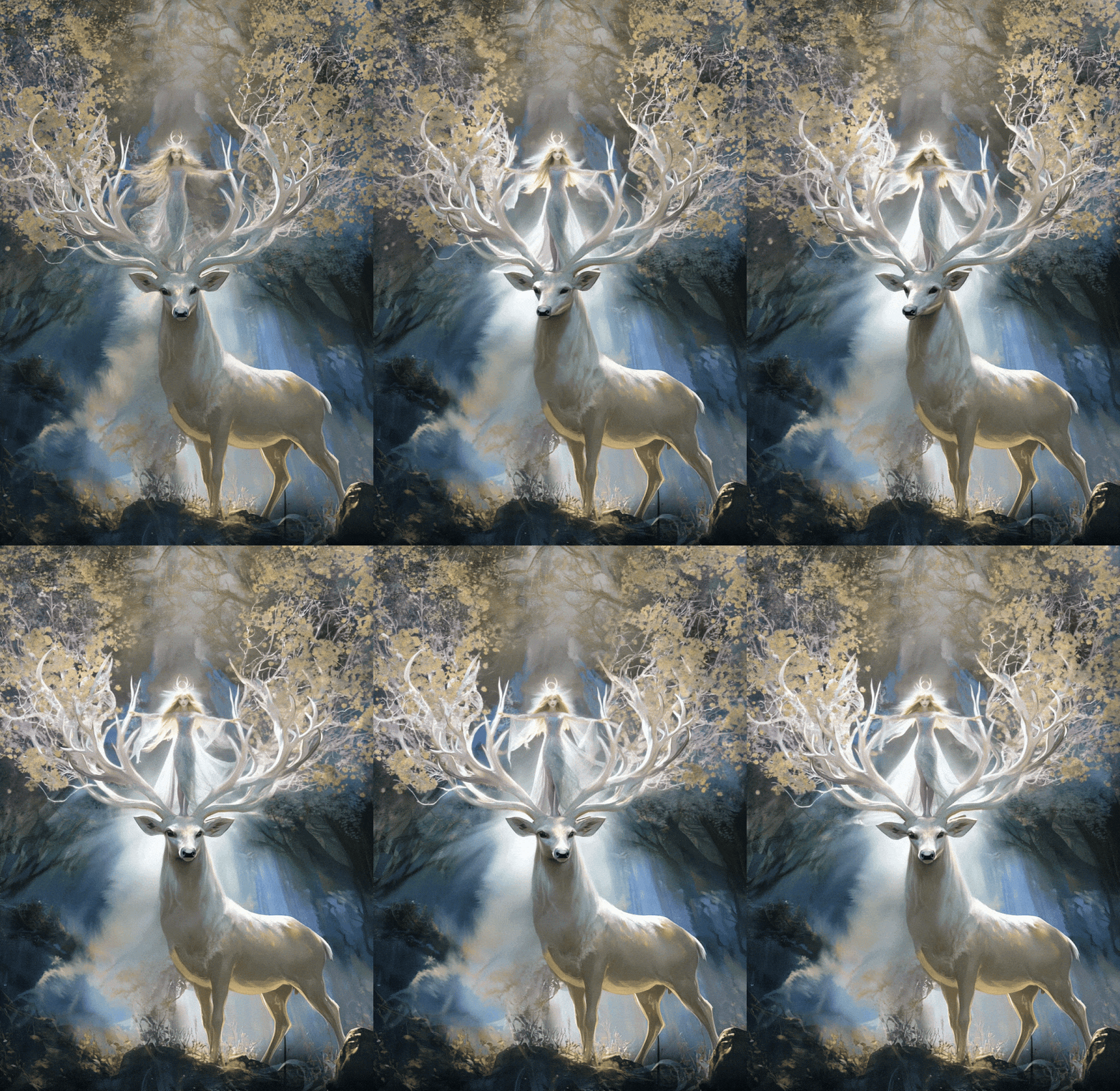
My art involves many processes, integrating varied techniques, and like an alchemical transmutation can involve layers of evolution. Hence, with White Deer - Rites of Passage, what appears to be a simple fairy tale on the surface, has deeply rooted symbolism, within the concept, in the words, and the imagery.

Robert Graves published, The White Goddess in 1948. It is a book that blends poetry, mythology, and anthropology, calling forth a historical grammar of poetic myth rooted in Moon-goddess worship, a spiritual tradition he contends was at the heart of early European poetic culture.

My White Deer project—though told through a contemporary, visual, and symbolic narrative—embodies a similar impulse to reestablish a sacred connection between the evolution of self, and the soul’s journey. In both The White Goddess, and White Deer we encounter an ancient consciousness that centers on the primordial feminine—not only as a divine figure, but as a guiding principle of creativity, identity, and truth.

"One stepped forward, eyes ablaze

A divine mystery displayed

White as the snow that gently falls,

Its coat aglow, like moonbeams"

Ancient rites, rituals, and myths are encoded in the language of metaphor, paradox, and dream logic. The White Deer in my poem is not merely a creature of the forest, but a totemic presence—a living echo of the Moon-goddess that Graves so painstakingly uncovers. This ethereal being is not there to be captured or understood logically. Instead it represents a call for a more intuitive mode of engagement.

Graves argues that the original language of poetry was not ornamental but magical—ritualistic, performative, and alive with divine presence. This language, he suggests, was spoken in the ceremonies of goddess worship. The bards, the poets, and the priestesses of ancient rites did not write to entertain, but to invoke, to transform, to offer the soul back to itself.

"Bowing low in benediction

Its prayer revealed my afflictions

Opening these eyes to see

Fearless, is who I am to be"

Animation test for White Deer - Rites of Passage

White Deer channels this same sense of ritual and invocation. A coming of age girl is pulled into a vision of a mythic landscape where the ordinary laws of reality no longer apply. This “call of the wild,” is her invitation to cross over to adulthood. This crossing is not physical and psychological alone—it is spiritual, cosmic.

The enchanted forest, the other worldly specters, the dreamlike deer are visual metaphors that evoke the same primal mythic language essential to the Moon-goddess's rite.

At the heart of this journey lies a rite of passage—a transition between worlds, selves, or states of consciousness. The young female is chased by her imaginary future selves into the sanctuary of the White Deer clan. The known world is left behind to confront loss, transformation, and ultimately, integration. In The White Goddess, this process is mirrored in the bard’s ordeal—a journey through madness, exile, and ecstatic communion with the Muse. Graves emphasizes that this journey is not optional; it is the price of true inspiration, and it demands total surrender to the goddess.

The mythic feminine acts as initiator. She is not passive but directive; not nurturing in a maternal sense, but demanding and mysterious, calling the seeker into contact with life, death, and rebirth. This reflects Swiss Jungian analyst and scholar, Marie-Louise von Franz’ view of fairy tales, as concerned with the “rightness of action” and the abstract essence underlying reality. The White Deer leads us not to knowledge but to gnosis—not to answers, but to a deeper, symbolic ‘rightness’ with the cosmos.

"Courage and strength within me stirred

No longer a victim of destiny

I felt the surge of alchemy

A miracle, my body changed"

In Jungian terms, this rite of passage reflects an encounter with the Self—a concept Jung describes as “often symbolized as an animal,” especially in dreams. The White Deer, then, is more than mythic; it is the symbol of the Self, that archetypal core of the psyche that is “woven into the whole world, both outer and inner.” The appearance of this animal spirit marks the beginning of the integration of opposites, a union of masculine ego with feminine soul.

Animation test for White Deer - Rites of Passage

There is a disconnect between masculine rationality and feminine intuition that defines much of modern culture. Centuries of patriarchal shift replaced the Muse with Apollo, the living goddess with abstract logic.

There is much healing that is realized through the reintegration of the feminine. Poetry’s original purpose was to serve the Muse, to speak in the sacred tongue, to echo the rhythms of life.

The feminine here is archetypal, cosmic, and initiatory, not reduced to gender roles. The masculine hero must surrender not to a woman, but to feminine wisdom—to mystery, to nature, to spirit. This surrender is not weakness but strength, a reclaiming of a deeper, mythic masculinity in alignment with the sacred feminine.

"Human essence, animal lore

Revealed a truth forevermore

Immortal, full of grace am I

Fierce love with life’s battle cry"

Returning to the mythic, does not mean necessarily replicating ancient rituals, even though that could be powerfully effective. It means reawakening the sacred imagination—maps for the soul.

It is my experience that art in all its forms, like threads of insight and inspiration can help weave illumination for our transformational journeys. In White Deer - Rites of Passage there is an integration of many threads. Each thread reminds us that we are living, breathing myths of our own making.

"Now I stand, symbol of the wild

Girl and woman reconciled

Not only Goddess, do I see

I am Sovereign, Eternal, Free"


Bibliography

  • Graves, Robert. The White Goddess: A Historical Grammar of Poetic Myth. 1948.

  • von Franz, Marie-Louise. (1999). The Interpretation of Fairy Tales.

  • Jung, Carl. (1964). Man and His Symbols.

September 06, 2025 by Greg Spalenka
Read more

Between Forest and Sky: Antlered Spirits a Journey of Initiation

Cross-cultural symbolism in myth, ritual and White Deer - Rites of Passage

Across time and cultures, deer and reindeer antlers have emerged as sacred symbols woven deeply into humanity’s spiritual imagination. Their cyclical shedding and regrowth mirror the eternal rhythms of life, death, and rebirth, making them natural emblems of regeneration and transformation. From the Celtic horned god Cernunnos to the Sámi sun goddess Beaivi, whose reindeer carries the light of the returning sun, antlers have served as metaphors for vitality, immortality, and cosmic continuity. In Norse myth, the stag Eikþyrnir nourishes the world-tree Yggdrasil with the dew from his antlers, reinforcing their role as vessels of divine nourishment and interconnection. These branching forms, echoing both tree and bone, stand as living icons of nature’s sacred geometry—rooted in earth, yet always reaching toward the heavens.


More than biological appendages, antlers function as spiritual antennae in shamanic and Indigenous traditions, marking beings who dwell between realms. Among Native American tribes such as the Apache and Yaqui, and in the reindeer-herding cosmologies of Siberia and Mongolia, antlered deer spirits are not merely animals but mediators—guides who assist in traversing the boundaries of the known world. In these traditions, antlers are worn in ritual, invoked in dreams, or carved into sacred objects, transforming them into tools for transcendence and wisdom. Whether as the Deer Woman guiding Lakota girls through rites of passage or as the reindeer bearing Sámi shamans across spiritual landscapes, antlers signify a connection to ancestral memory, seasonal renewal, and unseen dimensions.

These liminal qualities make deer—especially white, antlered does—central figures in feminine rites of passage. In cultures ranging from the Ainu of Japan to the Evenki of Siberia, stories abound of young women visited in dreams or forested thresholds by antlered guides who lead them through symbolic death and spiritual rebirth. Here, antlers act as world-trees—symbols of growth, resilience, and celestial lineage. Rituals involving antlered headpieces, offerings of acorns or birch leaves, and dances under oak or birch groves are not mere pageantry but embodied prayers, tracing a young woman’s journey from innocence to maturity with nature as her initiator. These practices affirm a deep-seated understanding: that feminine transformation is not only physical, but mythic and cosmological.

This mythic resonance continues in modern neopaganism and spiritual art, where antlers adorn the heads of archetypal figures like the Horned Goddess, the Forest Queen, or the Deer Mother. These motifs fuse ancient traditions with contemporary explorations of nature-based spirituality, gender, and power. The oak—long associated with endurance and wisdom—intertwines with the antler in symbolic artistry, representing the rooted yet ever-growing soul. Whether invoked in ritual stories, initiations, ceremonies, or modern theater, dance and popular art culture the image of the antlered woman or white stag now carries both ancestral weight and personal revelation, reminding modern seekers of their place within larger cycles of renewal and belonging.

It is within this rich symbolic terrain that White Deer – Rites of Passage finds its creative and spiritual footing. This graphic novel and multimedia project re-imagines the ancient tradition of the antlered guide and the story of a young girl’s journey into womanhood. Like Beaivi's reindeer, the titular white deer is a solar-lunar emissary—its antlers shimmering with cosmic potential, heralding transformation. The narrative draws deeply from the archetypal motifs found in Indigenous myth and European shamanic tradition, echoing stories where deer spirits emerge to guide the soul through thresholds of identity and purpose.

The symbolism in White Deer mirrors the sacred iconography of ancestral rites—tree-like antlers, forested dreamscapes, and feminine figures poised at the edge of becoming. Landscapes recall the “Forest of Unknowing,” a mythic domain where spirit and self dissolve into one, recalling both Siberian shamanic visions and poetic dream-journeys of Ainu and Mongolian maidens. In this visual odyssey, the antlers of the white deer are not mere decorations but radiant branches of spirit, reaching outward toward life’s mysteries. Through these symbols, the goal is to create a ceremony—an invitation for the viewer to engage in their own rites of passage across time.

The path through the woods can also be a path through the soul, and the antlers we follow are both guideposts and growing points—reminding us that to pass through life’s thresholds is to branch toward the sacred. The story of White Deer – Rites of Passage reflects a ritual in poetry, art, music, and film– subconsciously reminding us of the ceremonial lineage of the Deer Dance, puberty rites beneath birch groves, and the cosmic myths of multi-dimensional power animals. We honor the ancients, and the depth of their traditions invoking transformation. Between the earth and sky resides the White Deer a symbol of auspicious change—an antlered emissary not only of the forest, but of the inner self.

Stay tuned for more insightful stories about the creation of White Deer - Rites of Passage.

August 05, 2025 by Greg Spalenka
Read more

Mary Magdalene AI Transcendence

Last week I premiered Light of the Rose (mixed digital) my new 24” x 36” limited edition archival print celebrating Mary Magdalene...a timeless and powerful symbol of divine love.

Little did I realize that the creation of this uplifting and spiritual image would spark some controversy on Facebook. Throughout my career I have been transparent about my art techniques and have shared much of it in art magazines to inspire upcoming artists. As most of you know I am a devotee of experimentation and exploring new art making paradigms whether in the high touch or high tech realms. I am mostly fearless in this regard and have destroyed many pieces of art in the process of this quest.

Light of the Rose was predominantly loved with more than 222 likes and uplifting comments. Then someone asked, “Did you use AI at any moment in your mixed digital process?” and I responded with a description of the many, high touch and high tech processes I use, which recently has included some AI. Then the critics chimed in...

“GenAI is cheating, it's plagiarism, and it's by no means "virtuosic". It’s not a tool; it's automation. It does all the work for you, makes all the choices, at the expense of your fellow creatives. It really does feel like selling out.”

“…a program that chews through natural resources and disregards copyright, at the expense of your fellow creatives...and the thinking world.”

“Gonna follow real artists instead of people who sympathize with gen AI. Lazy. Why should anyone value your work if you can’t be bothered to do it all yourself like the rest of us?”

In my 45 years as an art professional I have heard much art criticism about my art and others. Everyone is entitled to their opinion, however it makes more sense that opinions are based on some factual information, or personal experience. Do these experts know the techniques I use to conceptualize the idea (which is the foundation of my art); or my work flow starting with sketches; composition; reference gathering; value studies; lighting; color comps; painting techniques; digital techniques; building/destroying textures; and the many other processes that make up a single piece of artwork, which may or may not include AI? No, they don’t because there is way to much of a dance between myself and the piece to determine the exact moves that artwork is going to take.

Tech has always been a disrupter. Whether it was the printing press putting illuminators out of work; photography competing with painting; the de-humanizing assembly line concept used for making automobiles and other items; computers taking over many positions in the publishing arena; electronic books; etc. There is usually an up side, and a down side. Hopefully we learn how to use the benefits in a holistic fashion, keeping in mind how it affects people, the environment, etc.

For instance, the way AI models were trained on other artist's work without the artist's permission, nor compensating them, was unethical by these companies and potentially illegal. Am I considered an accomplice to this artist abuse, and as one AI hater informed me, “that I am propping myself up by standing on the backs of artists.”

It is my experience, that we are all standing on the shoulders of creative giants, AI is standing on our shoulders now, we will stand on the shoulders of AI... it is the history of art, and will continue to evolve.

AI is a game changer, and I can understand why so many artists I know are freaking out and are blaming it for their diminished art careers. However, I think of all the artists (dead and alive) that have inspired and taught me during my lifetime, from museums to books and how I stored all that knowledge in the magnificent tech of my mind. I am still accessing that data bank for my creative purposes. It’s a little like AI… what a conundrum.

My art processes include many different high touch tools (just about every drawing and painting tool on the planet) and when the computer arrived on the scene, high tech tools (2d and 3d digital apps). Just depended on what was being produced and sometimes how fast a piece needs to be created i.e. deadlines, etc.

More important is my philosophy of making art, which has been a "no holds barred" approach in whatever technique I use, it includes a lot of process, experimentation, destruction and rebuilding of the image, whether it is drawn or painted or in some digital format.

AI is a powerful program, and like any form of reference or inspirational influence, be it a piece of art, photograph, film or artist style, it needs to be used responsibly and in the service of the artist's vision. I already know I can draw and paint anything I choose to produce using AI or not, so do not use it as a crutch or because I am lazy. I use whatever tools or processes available to elevate my personal vision and take it to places that I did not know existed.

I am a fierce protector of artist sovereignty, and this principle shaped my ethics, conceptual strategies, and image making practices. At the end of the day, whatever techniques I use must compliment the story that is being told in the image, communicate an idea or concept that brings us to a new awareness, and that the art is imbued with a sense of transcendence, touching people deeply. If I can accomplish that – fulfilling the mind, body, spirit attributes that I aspired to in the artwork, then I consider it a successful piece. After considerable effort, as is the case in learning any new technology, I feel like I am standing on the shoulders of AI… and the view is pretty spectacular up here.

Take a look at the conversations on that Facebook post. There was sublime and insightful dialogue, articulating the finer points of art creation within our world of evolving technology.

Here are a few highlights-

“With Generative AI being here to stay, just as it was the case with photography or the advent of Photoshop, as long as we immerse ourselves into a creative process, the artistic dialog between the all-that-is and the conduit, there will be art - whether we include AI or not. In the world of fine art - the question is more about how we can use it to incorporate it into the artistic process and elevate our vision and our message far beyond what’s possible with a single click of a button. The advent of new technologies is a call for courage to start a NEW conversation in the artistic creation process. Visual art will not and cannot exist in pencil and egg tempera or marble alone for all eternity. Evolution demands for this to become a ‘Yes, AND...’ –Silas Toball

“Interesting to see how Ai has become such a hot potato. My own feelings are I prefer not to use it, but there is no doubt that there has been some beautiful images made, and it will only get less and less obvious. The Mary Magdalene idea is stunning, however it was made. Being an artist of traditional methods, you have the creative advantage, like photographers who used film....it’s about tradition and respect for previous generations of artists.” – Nik Mather

“First of all, Greg, it’s a stunning image you’ve created, and it is your direction and understanding that created it. The conversation about AI and art is crucial now. AI is a powerful tool for creatives. We learn art through observation, imitation, and mentoring, synthesizing this over years of experience. AI has learned these aspects much faster. Much of the dissonance stems from misunderstandings of how the tools work and ethical frameworks applied to them.” – Peter Comitini

Back to Mary Magdalene…it was important to me that this representation of Mary, who is revered around the globe, evoked a spiritual vibration, connecting deeply to the viewer. My goal was to transcend the mediums used to create it, and in a word, produce a sense of awe. Was I successful? That is up for you to decide.

"Princess of the Magdala. Digital or not, love it." –Ralph Maheno

Mary Magdalene won over people’s hearts in that Facebook post, despite some AI detractors, because her message for the world has been about love and living from that sacred space within us. Celebrated for over two thousand years, she is now seeing a resurgence of her teachings.

Some prints are still left in this special limited edition-

Go Here to Purchase Light of the Rose

Go Here to Learn More about Mary Magdalene and the Art

The Feast of Saint Mary Magdalene is celebrated in various forms on July 22nd. There is a special gathering in Santa Fe and Roxana Villa and Shiva Rose co-created a beautiful Mary Magdalene anointing oil.

July 11, 2025 by Greg Spalenka
Read more

Light of the Rose - Mary Magdalene

Light of the Rose (mixed digital) is my new 24" x 36" limited edition print representing Mary Magdalene... a timeless and powerful symbol of divine love.

Mary Magdalene's story, often distorted or suppressed, is now emerging from the shadows, revealing her as a powerful archetype of boldness, sensuality, and spiritual mysticism—traits shared by countless women throughout history, such as Lilith, Cleopatra, Hildegard Von Bingen, and Joan of Arc—women who defied conventions, faced rejection, and exemplified the profound strength of feminine sovereignty.

Mary Magdalene has different origin stories, one being that she lived in ancient Egypt where her deep roots as a myrrhophore using sacred oils for anointing rituals, birthed a spiritual awakening before her association with Christianity.

Another version is she grew up in the town of Magdala, growing up in an affluent family along the shores of the Sea of Galilee. From a young age, she developed deep spiritual intuition, and learned to create preparations for healing and ritual purposes. Mary's use of spikenard, a fragrant and costly oil, was treasured in ancient cultures for its calming and restorative properties. When she anointed Jesus, it was an act of deep devotion and reverence.

She embodied the divine feminine power to heal, transform, and elevate consciousness, echoing her relationship with Jesus, who recognized her as "the apostle of the apostles."

The rose is Mary Magdalene's symbol—a flower representing deep love, beauty, and spiritual awakening.  She is the universal archetype of love’s transformative power, serving as a bridge between earthly and celestial realms. We are inspired to connect deeply to our intuition, the heart center and what Mary calls the vibration of True Care.

Like an energetic thread weaving through time, Magdalene’s essence continues to unify our shared humanity. Her commitment to love is especially important now in the Middle East, where reconciliation is desperately needed.

Today, in what many call a Great Awakening, her sacred offerings and ceremonies are being unveiled anew. Light of the Rose was created to celebrate Mary Magdalene on her feast day, July 22nd. Images like this can be used as a visual talisman, to remind us of what is important in our lives.

There is much symbolism in this piece of art:

-The pink rose represents, gratitude, joy, divine feminine energy.

-The hair transforming into a veil becomes the divider between mortal and divine realms as well as a shield protecting sacred knowledge.

-The anointing vessel she holds symbolizes a precious ritual act, sanctification, dedication, and the impartation of divine favor. The act of anointing consecrates the individual or object making them sacred. 

-Water represents baptism and the subconscious. Initiation, purification, rebirth.

-Sparks of the universe reflect a cosmic aura.

The mantra to be heard within your heart when viewing this image is, "I am one with the divine, I anoint myself with the vibration of love and peace."

COLLECT NOW


THIS SPECIAL EDITION IS LIMITED TO 10 PRINTS. These are large, gorgeous museum quality prints! They will be shipped the second week in July. 

Light of the Rose is 24” x 36" (with a 1" white border top and sides, 2.5" border bottom) on museum quality, archival, acid free, 100% cotton rag paper, numbered, signed, and embossed with my newly designed official seal. Each print is produced to the highest standards, and inspected by me so your artful investment becomes a source of lifelong satisfaction and enduring value.

***

In Addition...

Myrrhophore, a Mary Magdalene Anointing Oil

Roxana Villa and Shiva Rose have collaborated to bring you an anointing oil that has been designed to connect deeply into a remembrance of self and what Mary calls the vibration of True Care and the Sacred Sisterhood. Learn more here.


June 24, 2025 by Greg Spalenka
Read more

Adventures in Photopolymer Printing


As I finish the White Deer - Rites of Passage graphic novel, mainly using digital tools and processes, my high touch art making talents (drawing, painting with traditional materials) are usually waiting impatiently in the background for an opportunity to jump into the fray. My brain and heart keep screaming to get off the damn computer!

I love to fuse high tech with high touch art processes to meld the modern with the ancient, to create new alchemical visions. Learning about the various traditional printing options such as, relief printing, intaglio, planography, collagraphy, viscosity printing, and stencil printing (there are many subsets within these categories) gave me a lot of choices to explore. The photopolymer technique falls under the intaglio process and resonated with me.

Fortunately, I was able to work with master printmaker, Jennifer Lynch here in Santa Fe to explore this technique with an amazing etching press at her studio. The video above showcases some highlights.


Creating a photopolymer print with involves a delicate dance between chemistry and craftsmanship. First, the image is transferred to a transparency, then onto a light-sensitive photopolymer plate, which is then exposed to UV light (by the sun or a UV exposure unit), which hardens the areas that will hold ink (all very technical and not my favorite part of this process). After washing away the unexposed, soft polymer, the plate is dried, then ink is applied, pressed into the textured surface. The plate is placed on an etching press with paper or other material, and pushes the ink into it.


This meticulous process allows for intricate detail and subtle tonal variations. The tactile qualities of the ink impressed into the paper give it a hand made feel, which I really like. Variations can be explored by adding other colored inks to the plate, scratching it, drawing on it, layering different plates, or working over the print itself with paints, etc. My next session with Jennifer will include making larger plates and making grids of the imagery to create larger, more epic pieces on canvas.


Photopolymer printmaking makes it ideal for limited editions, however the initial setup and purchasing of supplies can be costly. Ultimately what I like about this technique is that it echoes the contemplative spirit of traditional printmaking while embracing contemporary innovation. A perfect high tech / high touch combination.


June 06, 2025 by Greg Spalenka
Tags: etching photopolymer printing printingpress whitedeer
Read more

I Ching Oracle Deck - The Card Back

My art for the I Ching Oracle deck created in collaboration with Mei Jin Lu is finished. The final card text and box design spearheaded by Jeff Burne is still in the works. It's all coming along beautifully, just not certain when the actual launch will be. Mei is looking for the right publishers and distributers around the world, because this is an incredibly powerful, one of a kind deck. 

Closer to actual size.

When it comes to divination decks it is usually the card front that receives all the glory because each one has a unique story to tell. However, the card back also has a story, but it must be universal and encompass the vision of the entire deck. Most of the time the card back is geometrical, ambiguous, or abstract so as not to make to much of a statement unto itself. It is suppose to support the deck as a whole, but not bring to much attention to itself.

The card back for my Divine Nature Oracle is an example of a geometric design that I felt was successful. I imbued it with underlying symbolism, but it is still mainly an abstract design.

This I Ching card back represents a departure from the geometric and moves into the realm of symbolic narrative. There are many esoteric facets to be explored within all the various motifs in this image as Chinese iconography is very complex! This art alone has upwards of 20 symbolic references, some which can only be seen with a magnifying glass! Some questions arise when viewing this image– is it a landscape or not, is it a building or not, what are those descending circles?

A few hints– all of the elements represent parts of the I Ching and Chinese historical lore.

Heaven and Earth- the qi of earth ascends, the qi of heaven descends. In this fashion, yin and yang dance with each other, and heaven and earth merge in an undulating embrace.

Peony Flower- known as the “king of flowers” in China, the peony symbolizes opulence, beauty and honor.

Clock at 4:00- symbolizes the truth of time passing by. It is a reminder that all relationships and eventually life have an end. Even though 4 has a derogatory connotation in Chinese, it is still popular in the culture. For example, Four Greatness (the greatest natural power that human should abide by) in Buddhism refers to Earth, Water, Fire and Wind, while Tao, Heaven, Earth and Human are the Four Greatness of Taoism. Furthermore, the ancient Chinese people took benevolence, righteousness, courtesy and wisdom as Four Moral Criterions.

See if you can figure out some of the others!

There are many more mysteries within the image, all to say that the I Ching is an infinite source of knowledge and wisdom. I can say from my own experience that the I Ching works! Mei has that ancestral DNA from her lineage and she has imbued every card with that wonder and power. I pulled up all my resources to create the art that would match the vibration. It was a long, hard journey, and Mei and I almost gave up a few times! So it is my hope and prayer that even the card back emanates I Ching's 5000 year power of divination.


April 09, 2025 by Greg Spalenka
Read more

Time Lapse Drawing

January 30, 2025 by Greg Spalenka
Read more

Fabled Woods Limited Edition Print - Ends January 19


Fabled Woods, Digital 
Innocence is a mystic trance
In light of day, where shadows dance
The gifts of nature can be found
In verdant woods of fabled ground


In 2023, I began a graphic novel called, White Deer - Rites of Passage. The White Deer is a symbol associated with myths and lore from around the world. This graphic novel is based on a poem I wrote reflecting upon life's transitions, especially from childhood to adult. 

This illustration mirrors the different aspects of spirit and nature we understand and embrace as children. Our innocence and connection to subtle energies reflect an infinite imagination. The immortal unicorn wades into the stream of our consciousness to remind us of what is good and holy.

Innocence is a mystic trance
In light of day, where shadows dance
The gifts of nature can be found
In verdant woods of fabled ground

More to come about the White Deer graphic novel, but until then you can support the project by acquiring a stunning, limited edition, museum quality print. 

PURCHASE HERE


THIS LIMITED EDITION PRINT IS BEING OFFERED IN A TIMED SALE ENDING AT 11:59PM (MST) ON SUNDAY, January 19th, 2025. AFTER THAT THEY WILL NO LONGER BE AVAILABLE AND THE EDITION WILL BE BASED OFF THE TOTAL NUMBER SOLD. PRINTS WILL THEN BE MADE WITH MY SUPERVISION, AND SHIPPED AFTER THAT PROCESS, ABOUT A WEEK LATER.

 Fabled Woods is 27” x 30" (with a 1" white border top and sides, 3" border bottom) on museum quality, archival, acid free, 100% cotton rag paper, numbered, signed, and embossed with my newly designed official seal. 

January 05, 2025 by Greg Spalenka
Read more

Blessings II, Limited Edition Print - Ends October 20th


The concept of the Nurturing Goddess is symbolized throughout the world and needed more now than ever. Blessings II is a reflection of the bounty we receive from the Divine Mother. My intention with this image is to remind us that this immortal essence lives within the spirit of our soul and our planet. There is enough for all of us if only we open our hearts to realize the bounty within us.

 The original Blessings art (above) was created in the 90's for, Project Open Hand which provides nutritious meals to sick and vulnerable people in San Francisco and Oakland. The image was used as large illuminated bus shelter banners around the city. It was a thrill to see them all lit up. I am gifting a portion from the sales of this new print to them.

Blessings II is part of my Redux Print Limited Edition Print Series. These begin as existing images of mine that I bring into an AI program then brainstorm and manipulate them into alternative versions. I finalize them in Photoshop. It is a similar technique that I used when creating my "Progressions" except these spin offs become digital prints only.

The goal is to keep the spirit of the original piece of art, yet create a new vision from it. 

The foundation of my art career is based on unique ideas and pushing the boundaries of my image making materials, so AI becomes a new digital brush in my tool box. 

The mantra to be heard within your heart when viewing this image is, "I am grateful for the eternal blessings of love, peace, health and prosperity."

THIS LIMITED EDITION PRINT IS BEING OFFERED IN A TIMED SALE ENDING AT 11:59PM (MST) ON SUNDAY, October 20, 2024. AFTER THAT THEY WILL NO LONGER BE AVAILABLE AND THE EDITION WILL BE BASED OFF THE TOTAL NUMBER SOLD. PRINTS WILL THEN BE MADE WITH MY SUPERVISION, AND SHIPPED AFTER THAT PROCESS, ABOUT A WEEK LATER.

Blessings II is 18” x 32" (with a half inch white border top and sides, 2.5" border bottom) on museum quality, archival, acid free, 100% cotton rag paper, numbered, signed, and embossed with my newly designed official seal. 

 $250 Buy Now

October 13, 2024 by Greg Spalenka
Read more

Mythologies II


I am honored to announce that I produced art for the new Danaë Xanthe Vlasse album, MYTHOLOGIES II and its up for another Grammy! I created the cover art and inside illustrations for her first Grammy winning MYTHOLOGIES album two years ago. The Royal Philharmonic Orchestra performs on this second version to great effect. I know everyone is hoping for another Grammy win.


Sopranos Sangeeta Kaur and Hila Plitmann embody iconic characters from ancient Greece. Here Sangeeta represents Medusa, a beautiful priestess devoted to the goddess Athena who was transformed into a Gorgon, played by Hila. 

Greek mythology has persisted for thousands of years because those stories speak fundamental truths about the human condition and what we value in society. 

The above image reflects the Andromeda composition. In the story, Queen Cassiopeia offended Poseidon (the god of the sea) when she boasted of her daughter Andromeda’s beauty. Poseidon reacted by sending a deluge of tides and a sea monster named Cetus to ravage the land as a penalty. An oracle predicted that the kingdom might be spared from starvation if Princess Andromeda is sacrificed to the sea serpent.

Here I show Perseus arriving on Pegasus for the showdown.

All images were conceptualized and designed, then produced using photographic reference, Photoshop, AI elements and a heavy dose of evolving happy accidents.

More images were created and these will most likely be shown in a follow up album. 

July 18, 2024 by Greg Spalenka
Read more
« Previous Page 2 of 35 Next »
© 2026 Greg Spalenka.